Showing posts with label religion. Show all posts

10 July 2012

Birthday Celebrations

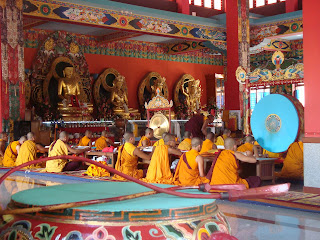
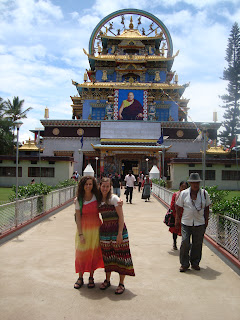
The Golden temple on 7.7.12
Sitting on a cinderblock for the sake of preserving memories.

It was His Holiness the Dalai Lama’s birthday on Friday, July 6th.  After feeling a little melancholy over missing our American 4th of July, this weekend was more than enough to make up for the loss. The celebrations were massive and dripping with cultural beauty unparalleled at any other cultural event I’ve attended.  It was actually my dream come true to sit right next to the stage two nights in a row with the Karuna children and staff through Tibetan dances, songs, and even Tibetan operas. 


            The first day, 6 July, we were at His Holiness’ palace in Camp 8 all day sitting cross-legged in fancy chubas with the sweet Karuna kids while watching performances of their native culture.  The slight 
Giving khata.
resemblance to Native American culture was quite interesting to me, and after this trip and especially after these performances I fear I’ll be partial to Tibetan culture for the rest of my life.  Several times I’ve turned to my roommate saying, “These people are the most beautiful people on the planet.  In every way.”  Maybe it’s a stage of culture shock, but I feel like I can no longer count on my fingers and toes the number of sincere acts of selfless, calm, peaceful kindness I’ve witness among the Tibetans.  A few times I’ve seen acts such as these and remarked, “In America, the receiver of this kindness would say in return, ‘Now how much kindness do I owe you?’”  Maybe not in America, but perhaps just my county culture, family culture, or maybe even myself! 


Anyway on His Holiness’ birthday we spent all day with my beloved Karuna people, and the evening was spent celebrating a teacher’s son’s birthday party at which he was swimming in those white scarves the Tibetans gave me on the day I arrived (khata) while sitting on a little stool accepting small gifts from friends and family.  After this we joined Rinpoche at yet another birthday celebration in Camp 8 at a cultural center that Rinpoche built for the camp.  Camp 8 is one of the poorest camps among the refugee settlements, so Rinpoche made a contribution by building a beautiful cultural center for the people to worship at. You know it’s work of Rinpoche and his wife because of the beautiful decorations, but straightaway you can tell because of the “Karuna pillars” that hold the construction up.  They are identical to the beautiful gray pillars holding up every roof and building at Karuna.  Well so we dined with Rinpoche at a front table overlooking the residents of the camp.  We were able to watch Rinpoche cut the cake for His Holiness and then place khata around a cutout picture of His Holiness above the cake.  When they brought us a piece of cake I whispered to Britney, “His Holiness is lookin’ out tonight.”  I was starving and the cakes along with the fabulous meal were pure gifts.


Dinner at Camp 8 with Rinpoche.
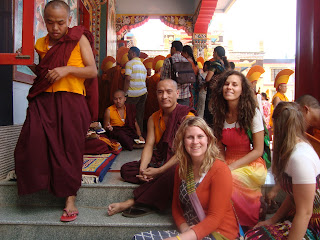
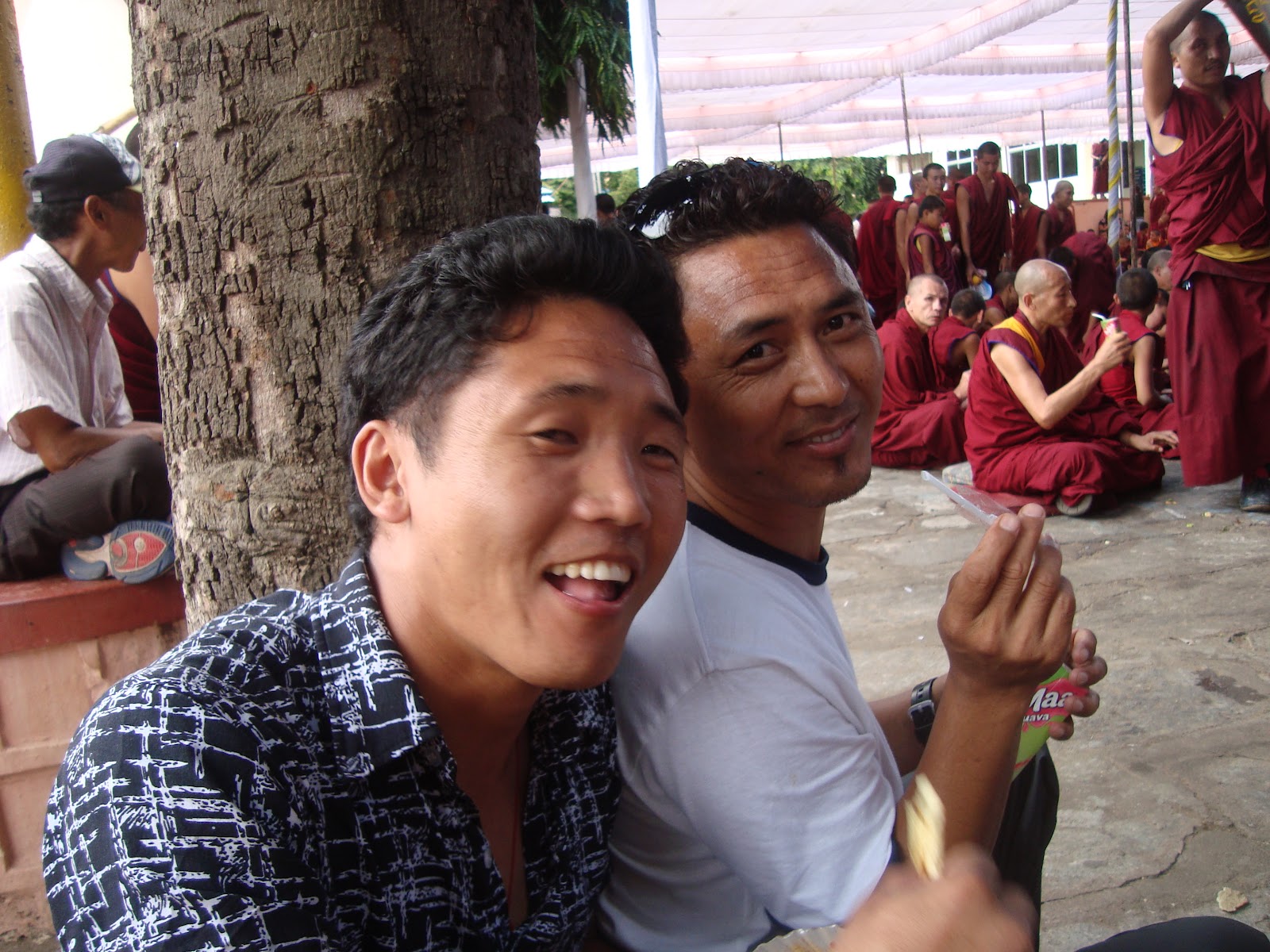
On 7 July, my roommate and I started out in India, I mean actually India: Kushalnagar.  It was dreadfully hot and we both dripped with sweat while we struggled up and down the streets in search of a massage parlor.  We miserably failed, but in the process ended up getting ice cream at least once (I, of course, stopped for another), seeing a dog with its brains falling out of the side of its head, and made good friends with an Indian rickshaw driver (who later that evening proposed to me) and two Tibetans from Nepal.  After Kushalnagar we went to the golden temple, and then to Sera, which are the most cherished couple of hours I have had since being here. 


Friends from Nepal!
Friends from Nepal 2.

 After strolling along Sera monastery and getting a few free rides around Sera Mey and Sera Jey (finally we seriously know there are 2 completely separate monasteries), we found ourselves in Sera Jey eating a meal free at cost with about a thousand other monks.  It was astounding to watch every person get fed a giant piece of sera bread, some vegetable-something-rather, mangos, and a juice box. I can recall at least four other times witnessing the Tibetans feeding tea, rice, and other food to groups of hundreds.  This first few times I thought with a smug impatient American look on my face, “Seriously?  Are they seriously trying to feed every single person here?”  After what seemed like only a few minutes, they successfully did just exactly that.  They indiscriminately fed every single person there!  The clean up wasn’t as successful as the feeding, but still!  The feeding happened. 


Feeding thousands at the palace.
Feeding thousands at Sera.

            At the Sera Jey monastery we saw performances again: Tibetan pop singers, yak dances, traditional Tibetan dances, and my personal favorite: the Karuna kids’ dances!! 

There are tears at every Karuna performance.  People love to see these students with special abilities show their devotion to the Dalai Lama’s cause, to the Tibetan cause.  I think they also love to see people with disabilities showing their different abilities.  Many have expressed shock at having seen how able the students at Karuna really are.  It’s inspiring for all those in the community, and all those out: me!!

Watching the show at the palace.
Sea of monks.
Yak dance at Sera Jey.
Watching the show at Sera.

            Before the show started, my roommate, Geshe La, and I were saving spots for the students at the front of the stage.  We sat there among a sea of red and yellow monks admiring the beauty of the event when finally I caught a glimpse of a familiar face: one of the Karuna teachers.  Following the teacher were several students, caretakers, and other teachers, all familiar faces that I love and realized I had missed even for just one day.  Seeing them happily march in to take their seats was like watching family arrive for a big Christmas party or family reunion.  In that slow motion moment of watching my Karuna family walk to their seats at Sera I discovered that these people are no longer my “trainees,” “teachers,” “students,” or “research participants,” they are my dear friends and family.  Leaving Karuna will be exciting, but miserable.  I also realized this summer will likely not be my last in India.

09 June 2012

One Week


This is earlier this week: I woke up at 5 a.m. and went running in a rocky, weedy, wobbly piece of land that an orphanage and prayer rooms will be built for Karuna Home.  It’s the safest place, though, because the main road is the road near us and people die on it all the time.  It was really lumpy and muddy and it was only ½ mile per lap, and only if we got creative during the laps with crisscrossing and the like.


Tibetan camps. After running, showering and breakfasting, we went to get my protected area permit from the police station.  We thereafter took a rickshaw to town and bought groceries and other necessary items.  After this we met up with Beau and Lori and went to the Golden Temple and the Tibetan settlement camps.  It is the most auspicious day in Tibetan Buddhism.  Today is Saka Dawa, the day the Buddha was enlightened.  Karma counts twice as much today, I’ve been told, and because of this, many offerings and rituals were being done at the Golden Temple and throughout the camps.  It was spectacular.  Seeing the monks and the people worshipping was beautiful. The sounds, the smells, the sights, all of it was sort of unreal.  I kept thinking of my brother Brandon the whole time, who really was born in the wrong part of the world.  He should be among monks.  I also let my thoughts wonder to the “Free Tibet” movement while passing shops selling shirts, purses, bags, and other items with the phrase printed on them.  As I was witnessing the worshipping and reading the phrase and reflecting on Tibet, Tibet, I began to feel a strong sense of connection to the need for the movement, and a completely different interpretation of what it means.  These people really have been in physical, spiritual, and cultural bondage in many ways, and yet what they have to offer to the world is beautiful and such an asset.  Without getting uncomfortably emotional, let it be noted that I was totally floored by what I saw today.

Children’s performance. Upon returning to Karuna Home, we were able to have a feast and watch a performance by the students.  I cried silently, of course, at the end of nearly every performance. Children with physical disabilities and mental disabilities—some mild, but most severe—were the stars of the show, and the people really loved seeing them.  No one was pitying them, they were admiring them.  It was fantastic.  I knew that these children are regularly relegated to beggars or other positions in life because of confused societal norms or inability to sustain them, but at Karuna they live.  They have such meaning in their lives. My participation was limited to sitting in the front row (!!) with my fellow BYU classmates and other visitors and monks while we ate snacks and drank soda.  At the very end of all the dances and song numbers the kids pulled us up to dance in front of everyone.  My dancing is like that of Elaine from Seinfeld, so they got the show of their lives.  My classmates probably felt ashamed when they saw the way my body moves. 

Research. The people here are extremely eager about getting teacher training from a special educator in a master’s program.  I think my sort of presence here is unusual—especially my being American.  Well I’m a Young American.  Like David Bowie says.  I’m a young American researcher/teacher/master’s student with many years experience and a very confused sense of humor.  The point is, people don’t want me sitting around here for three months watching them I guess.  Who would have thought?

After talking with two beloved professors from the excellent BYU, I’m relieved and happy to move forward with research.  They said it’s normal for ethnographies/case studies to have changing elements, and that I must complete my research as planned (at least interviewing and observing portions) prior to any training of staff, and that I could complete this in a shorter amount of time if things go well and train after. Completing big parts of the original research more quickly means I will be staying at Karuna thereafter entirely to train and volunteer and do other interesting research.  This makes me terribly happy, as I sometimes resent that I'm not intervening.  Soon!

02 April 2012

South Asian Muslim Immigrant Religious Beliefs & Autism


Jegatheesan, B., Miller, P. J., & Fowler, S. A. (2010). Autism from a Religious Perspective: A Study of Parental Beliefs in South Asian Muslim Immigrant Families. Focus On Autism And Other Developmental Disabilities, 25(2), 98-109.

Islam views of disability. Like individuals of the LDS faith, Muslim parents have expressed a feeling of gratitude when responding to questions about having a child with a disability, autism specifically.  They believe that Allah, their god, sent the child with special abilities and needs to their family.  According to these parents, Allah selected them based on their “moral character, loving nature, and resilience; their ability to protect the child; and their fate or Karmic connection to the child” (Jegatheesan, Miller, & Fowler, 2010, p. 101).  The parents of the Muslim faith felt honored to be the parents of a child with special needs

28 March 2012

Buddhism & Hinduism


So in class last week we discussed briefly the similarities and differences between Buddhism and Hinduism.  I actually left class more confused about the topic than when I entered.  Here are some brief key points I found while studying the similarities and differences.  My understanding has increased slightly, but still I feel pretty confused about the two religions.

Fun Facts I Didn't Know:


  • People say Buddhism is an offshoot of Hinduism, but Buddhists do not believe this.
  • Hindus think Buddha is an incarnation of Vishnu.
  • The founder of Buddhism was a Hindu.
  • Hinduism is not a religion.  It is “a group of religious and sectarian movements that share some fundamental and in some respects identical beliefs, regional variations, history, tradition and practices peculiar to the land and the times in which they originated and evolved” (V, 2010, para. 6).

Similarities:
  • Karma and reincarnation
  • Compassion and nonviolience toward all living beings. 
    • I still wonder…why do some eat animals, then?
  • Several hells and heavens
  • Gods and deities
  • Meditation, certain states of mind
  • Both have own versions of Tantra

Differences:
  • Hinduism not founded by particular prophet—Buddhism founded by Buddha.
  • Hinduism belives in Vedas—Buddhists don’t believe in Hindu scripture.
  • Hindus believe in Atman (a Supreme Creator), while Buddhists don’t believe in a “God.”
  • Hindus believe Buddha is an incarnation, Buddhists accept no Hindu gods as equivalent to Buddha.
  • Hindus aren’t organized monastically like Buddhists with monks living in a group.
Questions that Remain:
  • Does Buddhism have the blue gods?
  • How are both religions organized?
  • What are their churches/temples?
  • What are their beliefs about marriage?
  • Do they have something comparable to the 10 commandments?
  • Are they vegetarians, or what?  And why or why not?
  • Is there a Supreme Being or not?

V, J. (2010). Hinduism and Buddhism. Retrieved from http://www.hinduwebsite.com/hinduism/h_buddhism.asp

Religiousity & Autism


Ekas, N.V., Whitman, T.L., Shivers, C. Religiosity, spirituality, and socioemotional functioning in mothers of children with autism. Journal of Autism and Developmental Disorders, 39, 706-719. doi: 10.1007/s10803-008-0673-4

Again, it is important to consider the positive outcomes associated with the way people can better cope and find meaning when working with people with disabilities as a result of religion.  In a study of mothers of children with autism and spirituality and religiosity, mothers were found to have greater “life satisfaction, life enjoyment, positive affect, self-esteem, overall well-being, optimism and locus of control” (Ekas, Whitman, & Shivers, 2008. p. 7).  Religion positively affects parents of children with autism.  This is true of a study conducted in the United States, how is it at Karuna Home in India?