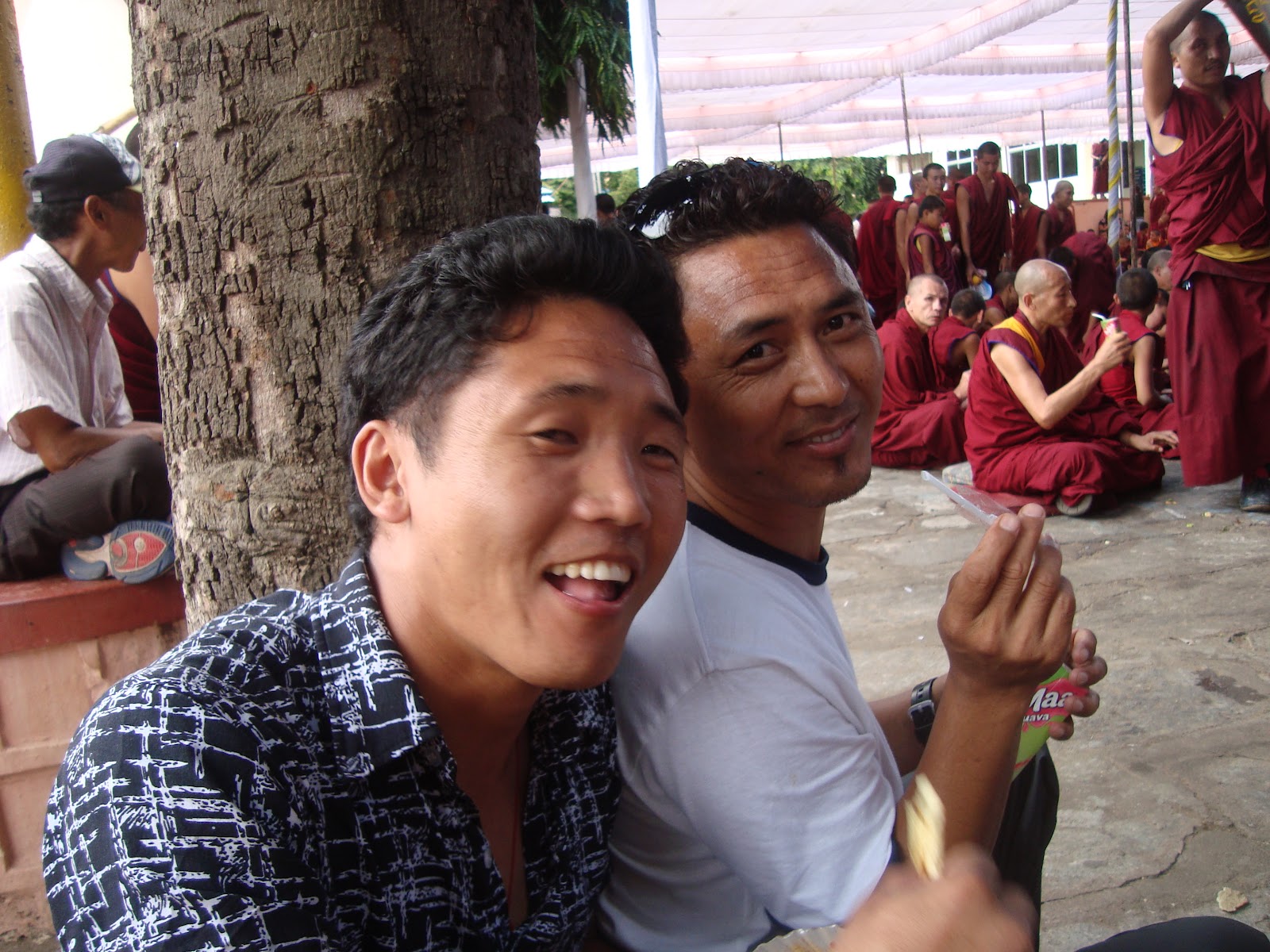
Sitting on a cinderblock for the sake of preserving memories.
It was His Holiness the Dalai
Lama’s birthday on Friday, July 6th.
After feeling a little melancholy over missing our American 4th
of July, this weekend was more than enough to make up for the loss. The
celebrations were massive and dripping with cultural beauty unparalleled at any
other cultural event I’ve attended. It
was actually my dream come true to sit right next to the stage two nights in a
row with the Karuna children and staff through Tibetan dances, songs, and even
Tibetan operas.
The first
day, 6 July, we were at His
Holiness’ palace in Camp 8 all day sitting cross-legged in fancy chubas with
the sweet Karuna kids while watching performances of their native culture. The slight
Giving khata.
resemblance to Native American
culture was quite interesting to me, and after this trip and especially after
these performances I fear I’ll be partial to Tibetan culture for the rest of my
life. Several times I’ve turned to my
roommate saying, “These people are the most beautiful people on the
planet. In every way.” Maybe it’s a stage of culture shock, but I
feel like I can no longer count on my fingers and toes the number of sincere
acts of selfless, calm, peaceful kindness I’ve witness among the Tibetans. A few times I’ve seen acts such as these and
remarked, “In America, the receiver of this kindness would say in return, ‘Now
how much kindness do I owe you?’” Maybe
not in America, but perhaps just my county culture, family culture, or maybe
even myself!
Anyway on His Holiness’ birthday we
spent all day with my beloved Karuna people, and the evening was spent
celebrating a teacher’s son’s birthday party at which he was swimming in those
white scarves the Tibetans gave me on the day I arrived (khata) while sitting on a
little stool accepting small gifts from friends and family. After this we joined Rinpoche at yet another
birthday celebration in Camp 8 at a cultural center that Rinpoche built for the
camp. Camp 8 is one of the poorest camps
among the refugee settlements, so Rinpoche made a contribution by building a
beautiful cultural center for the people to worship at. You know it’s work of Rinpoche and his wife
because of the beautiful decorations, but straightaway you can tell because of
the “Karuna pillars” that hold the construction up. They are identical to the beautiful gray
pillars holding up every roof and building at Karuna. Well so we dined with Rinpoche at a front
table overlooking the residents of the camp.
We were able to watch Rinpoche cut the cake for His Holiness and then
place khata around a cutout picture of His Holiness above the
cake. When they brought us a piece of
cake I whispered to Britney, “His Holiness is lookin’ out tonight.” I was starving and the cakes along with the
fabulous meal were pure gifts.
Dinner at Camp 8 with Rinpoche.
On 7 July, my roommate and I started out
in India, I mean actually India: Kushalnagar.
It was dreadfully hot and we both dripped with sweat while we struggled
up and down the streets in search of a massage parlor. We miserably failed, but in the process ended
up getting ice cream at least once (I, of course, stopped for another), seeing
a dog with its brains falling out of the side of its head, and made good friends
with an Indian rickshaw driver (who later that evening proposed to me) and two
Tibetans from Nepal. After Kushalnagar
we went to the golden temple, and then to Sera, which are the most cherished
couple of hours I have had since being here.
Friends from Nepal!
Friends from Nepal 2.
After strolling along Sera monastery and getting a few free rides around
Sera Mey and Sera Jey (finally we seriously know there are 2 completely
separate monasteries), we found ourselves in Sera Jey eating a meal free at
cost with about a thousand other monks.
It was astounding to watch every person get fed a giant piece of sera
bread, some vegetable-something-rather, mangos, and a juice box. I can recall
at least four other times witnessing the Tibetans feeding tea, rice, and other
food to groups of hundreds. This first
few times I thought with a smug impatient American look on my face,
“Seriously? Are they seriously trying to
feed every single person here?” After
what seemed like only a few minutes, they successfully did just exactly
that. They indiscriminately fed every
single person there! The clean up wasn’t
as successful as the feeding, but still!
The feeding happened.
Feeding thousands at the palace.
Feeding thousands at Sera.
At the Sera
Jey monastery we saw performances again: Tibetan pop singers, yak dances,
traditional Tibetan dances, and my personal favorite: the Karuna kids’
dances!!
There are tears at every Karuna performance. People love to see these students with
special abilities show their devotion to the Dalai Lama’s cause, to the Tibetan
cause. I think they also love to see
people with disabilities showing their different
abilities. Many have expressed shock
at having seen how able the students at Karuna really are. It’s inspiring for all those in the
community, and all those out: me!!
Watching the show at the palace.
Sea of monks.
Yak dance at Sera Jey.
Watching the show at Sera.
Before the
show started, my roommate, Geshe La, and I were saving spots for the students
at the front of the stage. We sat there
among a sea of red and yellow monks admiring the beauty of the event when
finally I caught a glimpse of a familiar face: one of the Karuna teachers. Following the teacher were several students,
caretakers, and other teachers, all familiar faces that I love and realized I
had missed even for just one
day. Seeing them happily march in to
take their seats was like watching family arrive for a big Christmas party or
family reunion. In that slow motion
moment of watching my Karuna family walk to their seats at Sera I discovered that these people are no longer my “trainees,” “teachers,” “students,” or “research
participants,” they are my dear friends and family. Leaving Karuna will be
exciting, but miserable. I also realized
this summer will likely not be my last in India.
Me & the nurse in our chupas. This is what all the teachers wear to work daily.
This week I had the privilege of training the special educators,
which was a pure joy. Training has
consisted of (1) how to take proper data, (2) writing objectives, (3) managing
problem behavior with positive behavioral supports, (4) teaching social skills,
and (5) how to deliver direct instruction.
Many discussions regarding individual student issues ensued as well.
It’s a real honor to train teachers at Karuna Home because they are so
incredibly humble. In fact, at the end of the second training the head
special educator asked me to come to her class to observe. No one
ever asks for an observer!! It was shocking. I’ve been observing
other classes instead of hers lately because I have already been in her class
over 10 times and I thought I was harassing her. But to my surprise, she
asked where I’ve been and requested that I take notes on behaviors and
instruction and disseminate the notes afterward. She is just so
incredibly humble, like most Tibetans I’ve met. Working with human beings
such as these has been inspiring.
Angels from home are assembling a giant package of items to
donate to Karuna Home to reduce problem behavior and increase learning. I made most of the list, but teachers slowly
started adding to it requesting specific items.
When I tell the teachers, “A big package is coming for you!” they look
so excited and express gratitude profusely.
Well, so, thanks for donating you guys. The kids will love it too.
This is earlier this week: I woke up at 5 a.m. and went
running in a rocky, weedy, wobbly piece of land that an orphanage and prayer
rooms will be built for Karuna Home.
It’s the safest place, though, because the main road is the road near us
and people die on it all the time. It
was really lumpy and muddy and it was only ½ mile per lap, and only if we got
creative during the laps with crisscrossing and the like.
Tibetan camps. After
running, showering and breakfasting, we went to get my protected area permit
from the police station. We thereafter
took a rickshaw to town and bought groceries and other necessary items. After this we met up with Beau and Lori and
went to the Golden Temple and the Tibetan settlement camps. It is the most auspicious day in Tibetan Buddhism. Today is Saka Dawa, the day the Buddha was
enlightened. Karma counts twice as much
today, I’ve been told, and because of this, many offerings and rituals were
being done at the Golden Temple and throughout the camps. It was spectacular. Seeing the monks and the people worshipping
was beautiful. The sounds, the smells, the sights, all of it was sort of
unreal. I kept thinking of my brother
Brandon the whole time, who really was born in the wrong part of the
world. He should be among monks. I also let my thoughts wonder to the “Free
Tibet” movement while passing shops selling shirts, purses, bags, and other
items with the phrase printed on them.
As I was witnessing the worshipping and reading the phrase and
reflecting on Tibet, Tibet, I began
to feel a strong sense of connection to the need for the movement, and a
completely different interpretation of what it means. These people really have been in physical,
spiritual, and cultural bondage in many ways, and yet what they have to offer
to the world is beautiful and such an asset.
Without getting uncomfortably emotional, let it be noted that I was
totally floored by what I saw today.
Children’s
performance. Upon returning to Karuna Home, we were able to have a feast
and watch a performance by the students.
I cried silently, of course, at the end of nearly every performance.
Children with physical disabilities and mental disabilities—some mild, but most
severe—were the stars of the show, and the people really loved seeing
them. No one was pitying them, they were
admiring them. It was fantastic. I knew that these children are regularly
relegated to beggars or other positions in life because of confused societal
norms or inability to sustain them, but at Karuna they live. They have such meaning in their lives. My
participation was limited to sitting in the front row (!!) with my fellow BYU
classmates and other visitors and monks while we ate snacks and drank
soda. At the very end of all the dances
and song numbers the kids pulled us up to dance in front of everyone. My dancing is like that of Elaine from
Seinfeld, so they got the show of their lives.
My classmates probably felt ashamed when they saw the way my body
moves.
Research. The
people here are extremely eager about getting teacher training from a special
educator in a master’s program. I think
my sort of presence here is unusual—especially my being American. Well I’m a Young American. Like David Bowie says. I’m a young American
researcher/teacher/master’s student with many years experience and a very
confused sense of humor. The point is,
people don’t want me sitting around here for three months watching them I
guess. Who would have thought?
After talking with two beloved professors from the excellent
BYU, I’m relieved and happy to move forward with research. They said it’s normal for ethnographies/case
studies to have changing elements, and that I must complete my research as
planned (at least interviewing and observing portions) prior to any training of
staff, and that I could complete this in a shorter amount of time if things go
well and train after. Completing big parts of the original research more
quickly means I will be staying at Karuna thereafter entirely to train and
volunteer and do other interesting research. This makes me terribly happy,
as I sometimes resent that I'm not intervening. Soon!
Recently I’ve been reading in Tibet, Tibet by Patrick French about Phagpala and Lhalu, who are both traitors to their homeland, Tibet. Patrick French contrasts and compares the traitors in an interesting way that leaves me wondering who is more of a traitor. Phagpala is known as a “hate figure” and father of a murderer, while Lhalu isn’t seen as a “committed” traitor, but a “pragmatic traitor.” Lhalu simply agreed to work for the CCPC and promote Chinese propaganda in order to ensure a comfortable life for his family, in hopes of them not growing up bitter and disadvantaged. However, when I read that rationale, I thought it was really unfounded. As a parent the greatest gift to be given to a child is an example of what it means to be a good person (which it is definitely a good person that worries about his family). A parent should be honest with integrity, striving to do the right thing.
Earlier today I was talking with a friend who is a parent to three adorable young children. He was relaying to me the fact that in high school he used to be very violent and beat on people frequently. I asked, “Are you going to tell your kids that?” He wasn’t sure if he would, of course, as he wants to set a good example. I explained that my parents acted on the same hesitation in my youth, and later on when I found out more about their pasts I felt a little annoyed at having such high standards and expectations placed on me by my parents; they themselves didn’t live up to some of them in their youth. Even though they were petty things like education, career, friends, etc., I still felt annoyed at the pressure I’d felt throughout my life, and that it wasn’t based on anything really except my parents “hope for a better life for me,” similar to that hope of Lhalu for his children (but not really, because Lhalu was dealing with life or death). I know this is a stretch, but I had a strong feeling that Lhalu’s children would could have in some way benefited in harder living conditions and seeing their dad fighting for what was right and being true to himself and his beliefs. Honesty and integrity under dire circumstances are such inspiring traits to witness. Seeing my parents as humans earlier in my life would have been beneficial not only to our relationship, but to my motivation to live up to expectations that were explained to me better. At the same time, however, I did see honesty and integrity in my parents all the time.
It must be said somewhere in here that I haven’t spent six years in Chinese prison and seen horrible torturous and murderous things, so I absolutely cannot really assess Lhasa's choice. All I can say as an outsider is that Lhasa could have gifted his family with something much different, and possibly greater, than a comfortable temporal lifestyle. I find much greater and lasting comfort in a comfortable spiritual and moral lifestyle (this does not necessarily mean mormonism ;)). Lhasa definitely traded something in agreeing to betray his people, his country, and even his religion.
In class on Wednesday we discussed art, culture, religion, and music in Tibetan settlements in India, and in India in general. The cultural discussions were enthralling, hearing the different kinds of modern Tibetan music was totally interesting, and always I love discussing religion—especially ones so vastly different from my own. However, when discussing art, I had a really hard time being… "artistic.” Art is beautiful. But analyzing art sort of kills it for me. I like to look at it--sometimes for longer periods of time, but often briefly—admire the skill it required to create it, and then just move on. Analyzing art, however, has never been appealing to me, probably because it’s so subjective. Anyway, in class it became painfully obvious that analyzing art, especially with artists in my midst, is still not a skill I have, bur more than that it’s not an interest. I have no desire to do it. However, when Rachel said we were “crossing disciplines” I felt an instant urge to improve the skill of analyzing art, even if it’s not an interest of mine. At the moment she used that phrase, analyzing art became a skill of being open-minded, well-rounded, and well, able to “cross disciplines.” It’s another way to relate to diverse groups. Now I feel almost a responsibility to improve my skill of analyzing art, at least in a way that helps me better relate to a culture or group. Being an expert in one discipline is great, but shutting out all other disciplines limits my ability to extend knowledge to many people.
So my resolution is to at least study pieces of art that I observe. I don’t think I’ll ever have a skill to be subjective and tell someone how a painting makes me “feel,” but knowing the history or cultural backgrounds to different pieces will give me a place to start understanding the source of the beauty of the art. Either that or it will totally kill the beauty of the art, which is my greatest fear. It’s worth trying though.
We've taken care of everything The words you hear, the songs you sing The pictures that give pleasure to your eyes It's one for all and all for one We work together, common sons Never need to wonder how or why
In class yesterday we all wrote quotes/ideas on the board from our current readings from Tibet, Tibet. The topic of duscssion was “vulnerable populations,” and my first thought was the word “control.” The past few chapters (7-10) have hit heavily on the idea that the Tibetan people are suppressed and their freedom is stripped, and thereafter or maybe beforehand control is assumed by the superior party. There are subtle and overt ways that the Chinese have taken power from Tibetans: religion was taken, religious buidlings destroyed, propaganda against their beliefs enforced, etc. The quotes that I chose to write on the board go as follows:
"They control us very closely, and stop us from practising our religion" (p. 82). "They teach us propaganda against His Holiness the Dalai Lama and then test us on it, to make sure we know the phrases. We will resolutely oppose the scheming activities of the tiny number of Tibetan pro-independence elements! We will safeguard the four basic principles and oppose bourgeois liberalisation!" (pp. 82-83) "We have to do what the Democratic Management Committee says, or we risk being expelled" (p. 82). "I have never taken part in a demonstration. If you do that, you might die" (p. 81). "Nuns and monks had been at the vanguard of public protests in Tibet in the late 1980s, and there were many documented cases of their being molested, tortured and killed, or driven to suicide while in prison" (p. 78). "...with much of eastern Tibet in open mutiny, truth was less important than adherence to the line emanating from the Chairman" (p. 68). "Anyone who displayed religious faith in Tibet, the Panchen explained, was persecuted as superstitious..." (p. 64).
The word "control" pervaded my thoughts throughout these chapters, and then one of my favorite Rush songs, 2112, joined the word control. As I mentioned in class, "Big Brother" has always terrified me since I was a kid, and even more so after reading 1984, Animal Farm, and other literature like this. It frightened me because it was so obviously easy for a group of people to lose total control and freedom to another group. A quote a once read in my history class in high school by Adolf Hitler said, "What good fortune for the government that the people do not think."
In looking at my diagram on the board I felt a sense of sadness and pain. It reminded me a lot of my students because they are in a definite position where advantage could be taken of them, and especially even 30 years ago. The way genocide happens is through a dictator or more powerful person/people taking control or freedom from an inferior counterpart.
Bangsbo, E. (2008). Schooling for knowledge and cultural survival: Tibetan community schools in nomadic herding areas. Educational Review, 60(1), 69-84.
“At the middle of the twentieth century, organized formal education in Tibet took place mainly in Buddhist monasteries and the few secular schools that existed were located in towns” (p. 70).
“It was not until 1986 that nine years of schooling became compulsory in China (PRC)” (p. 71).
“About 85% of the Tibetans live in rural areas where job opportunities in non-farm or non-pastoral labour are scares.A large part of the adult Tibetan population is illiterate and many Tibetan children do not attend school” (p. 71).
“There follows a presentation of two such primary schools, both founded by Tibetan Buddhist lamas (sprulku), of which one Tibetan tulku is an elected member of the county religious committee” (p. 72).
“The staff includes a devoted, by formally uneducated head teacher with several years of teaching experience from employment at the primary school in the nearby town” (p. 73).
Bangsho (2008) found that many Tibetan parents avoid sending their children to public schools in order to keep children safe, as they don’t need to travel far away and be away from home for long periods.Also, parents want to avoid a “nationalistic school environment” in which the Chinese flag is raised each day. They would prefer for their own ….(p. 75).
“Having a photograph of a local Buddhist lama would not be possible in a public school classroom” (p. 76).
A demographic survey of Tibetans in exile completed by the planning commission of Tibet’s government was conducted in 2009 and revealed that the Tibetan population “outside of Tibet…stood at 127,953” (paragraph 3).
Of the total population recorded, 94,203 Tibetans are living in India, 13,514 in Nepal, 1,298 in Bhutan and 18,920 elsewhere around the world (paragraph 5).
This is evidence that many Tibetans are still exiled to different countries and that the large portion of them are living in India. That's it!
Along with constantly reading scholarly articles and books, a new addition to my 2012 habits is occasionally checking the news. Working full-time and going to graduate school full-time doesn't make for prime quality "news-checking," but I've still made an effort to stay minimally informed. For the past four years I've been in school full-time and working, so news-checking really is a relatively new habit. Through writing my literature review and studying for this Tibetan class, I've definitely accidentally acquired a feeling of responsibility to stay more current, well really, less ignorant.
While searching self-immolation in Tibet after reading a few chapters in Tibet, Tibet I discovered that in the past few weeks there have been at least three self-immolations among the Tibetan monks and nuns in Tibet. I read three articles on the recent demonstrations:
Another Tibetan sets himself on fire in China
Another Tibetan has set himself on fire in western China to protest government policies while thousands marched in another part of China to show support for their exiled spiritual leader, the Dalai Lama.
An 18-year-old Tibetan nun has set herself on fire in western China in the latest such protest against Beijing's handling of the vast ethnic Tibetan regions it rules, an overseas activist group said.
Shadow of suicides over Tibetan New Year
40-year-old monk at the Bongtak monastery in Qinghai
All three articles were within the month and have some similarities, as well as some differences in the reported information.
They are similar in that all three articles discussed the fact that "the government has blamed overseas groups for the unrest, and said the measures were in response to 'secessionists led by the Dalai Lama [who] appeared more determined to plot conspiracies this year'" (http://www.thehindu.com/news/international/article2920441.ece). The "government" referred to in the articles is the Chinese government. All three articles relay the fact that the government blames the Dalai Lama for the self-immolations.
They all differed, however, on their reports of the number of self-immolation protests. One article said there have been 25, 16 of which are confirmed by the government. Another article claimed that 18 "monks, nuns and ordinary Tibetans have set themselves on fire over the past year," 12 of which resulted in dead (http://www.indianexpress.com/news/teenage-tibetan-nun-sets-herself-on-fire-in-china/911459/2). And lastly, the third article reported at least 17 monks, nuns, and Tibetans haveset themselves on fire (http://www.indianexpress.com/news/another-tibetan-sets-himself-on-fire-in-china/910077/1). In this article, the author alludes to the idea that the government is unwilling to admit that other reported self-immolations took place. The author said there "were reports of three other self-immolations on Friday" that the government denies. The differences in these reported numbers is not a result of articles being more recent or dated--simply different reports. It was disturbing to read that the government doesn't acknowledge all of the self-immolations, and it leaves me with a desire to continue researching.
Overall, it's shocking and sad to read of the demonstrations in Tibet. There is definite unrest among the Tibetans at having been denied the right to truly practice their religion and culture, in addition to having their leader and people exiled to another country. It's unjust that just persists because it's on another continent, and the people are in a vulnerable position.
McLoed Ganj, India is in the state of Himachal Pradesh and the Dalai Lama lives there in the Tibetan community in exile. The three major regions of Tibet are Amdo, U-Tsang, and Kham. Lhasa is the biggest city and the place where the Dalai Lama used to reside. Tibetans circumstances and lifestyles have changed as a result of their exile to India. The communities from the regions were being preserved in India. They preserve it through culture, dance, etc. and they even have a leader over each community. The Dalai Lama created the Tibetan Institute of Performing Arts to preserve the performing arts. Students there spend 10 years studying dance, culture, costuming, etc. Learning and Idea for Tibet (LIT) is a community organization that aims to remember Tibet and to prepare Tibetans to live in the evolving world. It was a community teaching people to dance, cook, etc. Music has been modernized; they don’t use traditional instruments as much because they synthesize it. It’s hard to find instruments.
Dance helps preserve Tibetans’ sense of identity. Dance also helps show the respect between elders and the people they teach. They have a deep respect for authority. Tibetan dances have distinguishing features, which is an obvious way to show the differences between Tibetans, Indians, Chinese, etc.
Ethnography. Ethnography was defined in this presentation in depth, which was very helpful to my current situation. When first brainstorming my project with my professor, we both studied ethnography as a possible way to approach the study. In the end, I think we decided it was too broad, and it wasn’t as appropriate as other methods for my particular study. Colby defined ethnography as the study of the people’s “ethos”: the tone, character and quality of life, its moral aesthetic style and mood and their worldview. Ethos also includes their picture of the world vs. how things actually are. My study will be more focused on specific ideas, and it will likely involve more case studies. I’m still not sure if ethnographies are more narrow, or strictly the study of perceptions of a group of people.
Zhiyong, Z. (2008). Reflections on basic education under the “three guarantees” policy in Tibet’s pastoral districts. Chinese Education and Society, 41(1), 44-50.
·“The blind quest for greater numbers of schools and students exceeded the actual needs and sustaining capacity of Tibet’s economic development, causing an imbalance in the internal proportions of education and a grave decline in the quality of education” (Doujie, 1991, p.98).
·They had a “bloated education system” in Tibet but the policy “brought some improvement to the quality of education” (p.45).
·The author maintains “that the low quality of education in pastoral districts has to do with the teachers’ identification with their roles.The behavior and demeanor of the teachers as they handle the relations among the state, schools, and students and their families are a far cry from the status of teachers as knowledgeable and ethical persons in positions of authority” (p. 48).
·Zhiyong finally asserts that there are definitely other possible causes for the issues in education in Tibet: “religious concepts, the errant mode of production and way of life in pastoral districts, the lack of economic development, the schools’ ecological environment, and so forth” (p. 49).
oThe “three guarantees” policy of having food, clothing, and housing was a good idea in theory, but didn’t get practiced very well.Through reading this article it appears as though people were going to school just so they could get food (as the policy encouraged this), and not to become a more educated society.However, it was a good incentive to get educated.The education in Tibet is “bloated” and of low-quality according to the author as a result of many factors listed above.